
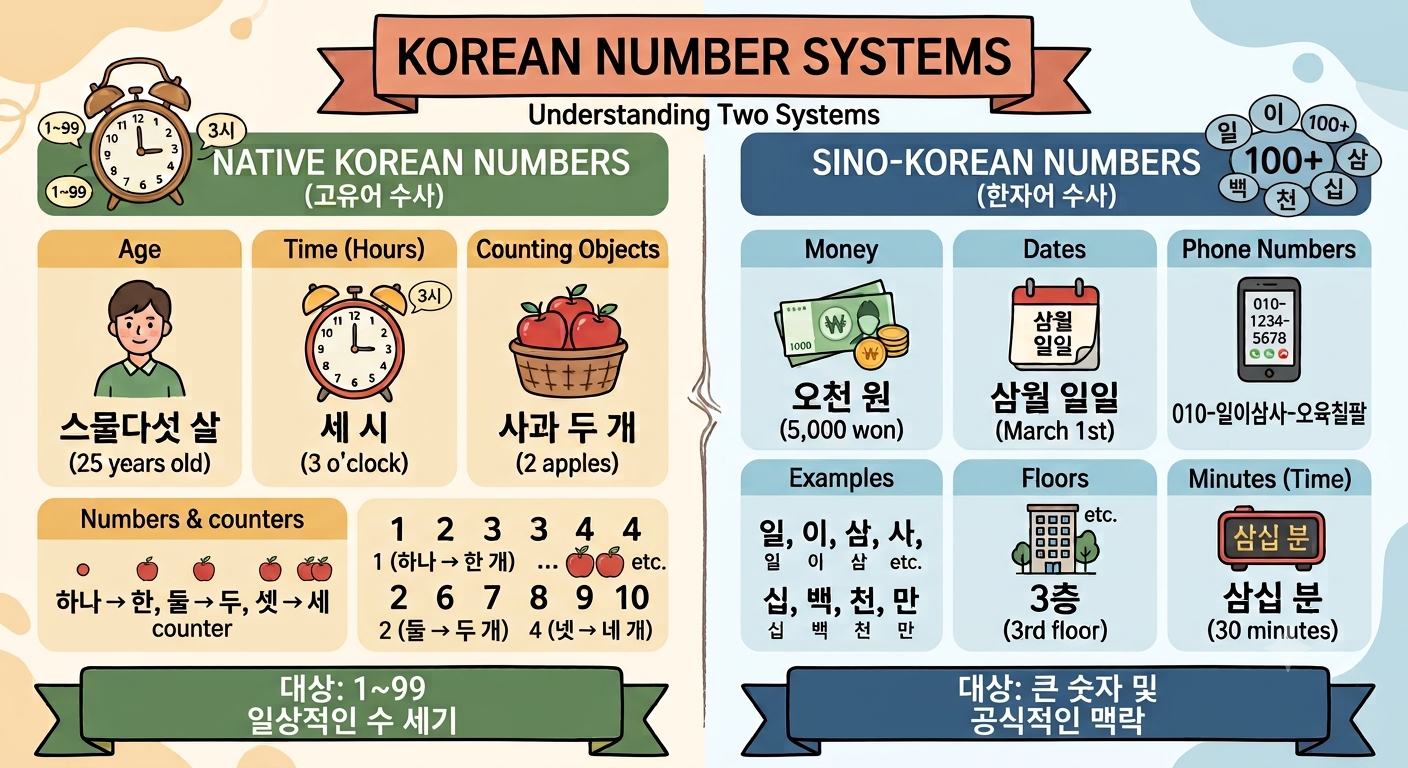
One of the most confusing parts of learning Korean is discovering that Korean has two completely separate number systems. Knowing which one to use — and when — is essential for everyday conversations.
The Two Number Systems at a Glance
| Situation | System to Use | Example |
|---|---|---|
| Age | Native Korean | 스물다섯 살 (25 years old) |
| Telling time (hours) | Native Korean | 세 시 (3 o’clock) |
| Counting objects | Native Korean | 사과 두 개 (2 apples) |
| Money | Sino-Korean | 오천 원 (5,000 won) |
| Dates | Sino-Korean | 삼월 일일 (March 1st) |
| Phone numbers | Sino-Korean | 010-일이삼-사오육칠 |
| Floors of a building | Sino-Korean | 삼 층 (3rd floor) |
| Minutes (time) | Sino-Korean | 삼십 분 (30 minutes) |
Native Korean Numbers (고유어 수사)
Native Korean numbers go from 1 to 99. Beyond 100, Koreans switch to Sino-Korean.
하나 (1), 둘 (2), 셋 (3), 넷 (4), 다섯 (5), 여섯 (6), 일곱 (7), 여덟 (8), 아홉 (9), 열 (10)
Note: When used before a counter (like 개, 명, 살), some numbers change form:
- 하나 → 한, 둘 → 두, 셋 → 세, 넷 → 네
Sino-Korean Numbers (한자어 수사)
Sino-Korean numbers follow a pattern from Chinese and are used for larger numbers, official contexts, and measurements.
일 (1), 이 (2), 삼 (3), 사 (4), 오 (5), 육 (6), 칠 (7), 팔 (8), 구 (9), 십 (10)
For numbers above 10: 십일 (11), 이십 (20), 백 (100), 천 (1,000), 만 (10,000)
Practice Both Systems
The best way to lock in Korean numbers is through repeated practice with audio. Try our free number quizzes:
- Native Korean Numbers Quiz — master 하나, 둘, 셋 with instant audio feedback
- Sino-Korean Numbers Quiz — practice from basics up to 99,999,999
Both quizzes are free and work on any device. No sign-up needed.